Car Sales & Drive Simulator 25
- 4.5
- Rating
- 10.00M
- Installs
- Free
- Price

 Analysis by App-foxy
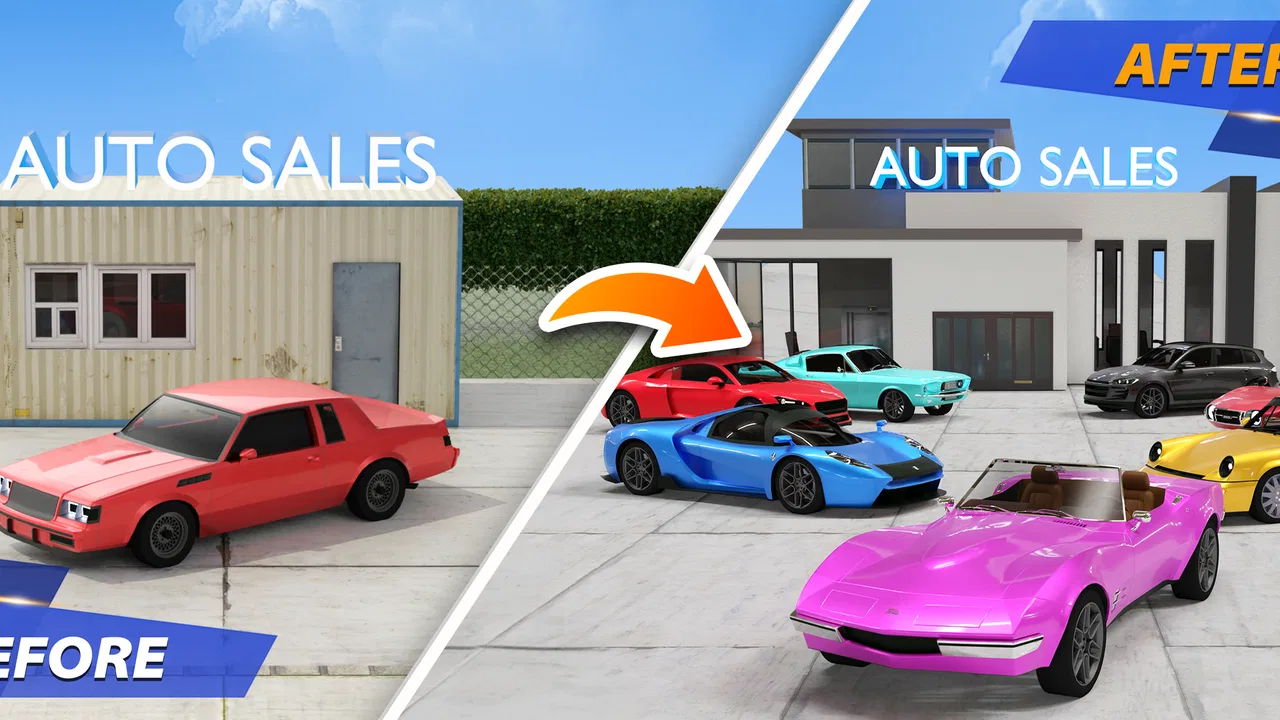
I approached Car Sales & Drive Simulator 25 expecting a straightforward car-trading game, but its appeal comes from combining several small jobs into one loop. I can inspect vehicles, decide what is worth buying, repair them, and then try to sell at a better value. That makes it more involved than a simple driving game, while still being easier to understand than a full business-management simulation.
This is a free simulation game from Skyloft Yazılım Bilişim ve Anonim Şirketi. It has built a sizable audience, with an average rating of 4.5 from around 169 thousand ratings and more than 10 million installs. Those figures suggest that the basic idea connects with a broad group of players, but they do not remove the need to look closely at the actual play loop. In my experience, the important question is not whether the game has cars, but whether buying, fixing, and selling them remains satisfying after the first few sessions.
How the first goals shape the opening
The early objective is easy to grasp: start turning cars into better deals. You are not asked to learn a complicated economic model before doing anything useful. The combination of purchasing, repairing, and selling gives each vehicle a clear purpose, and that clarity helps the opening feel approachable. I always prefer this kind of beginning in a simulation game because the player can make decisions immediately instead of spending the first session reading menus.
You May Also Like

 Blood Strike: 2.5 Anniversary
Blood Strike’s Loadouts Turn Every Drop Into a Tactical Gamble
A close look at Blood Strike’s custom loadouts: how fast access to signature weapons reshapes its battle royale rhythm, rewards preparation, and narrows the gap between fights.

 Pandora - Music & Podcasts
Pandora’s Music Is Easy to Start, but Harder to Recover
Pandora’s strength is its low-effort path from a seed to a station. Its weak spot is how much confidence it asks you to place in connection, setup, and quiet recovery.

 8 Ball Pool
 Is Built on Rivalries, Rematches, and Routine
A close look at the rivalries, rematches, shared routines, and unanswered safety questions that turn a quick pool match into a persistent mobile community.

 Samsung Music
’s Quiet Strength Is Playing What You Already Own
Its reach comes less from spectacle than from dependable access to a personal library. That simplicity is both the app’s strongest retention engine and its ceiling.

 AccuWeather: Weather Radar
AccuWeather Review: A Quick, Clear Forecast for Everyday Decisions
For everyday plans, the best forecast is the one you can understand quickly. AccuWeather makes rain timing, radar, and local conditions easy to act on, with a few trade-offs.

 Hill Climb Racing
Why Hill Climb Racing Still Turns Crashes Into One More Run
A tiny car, a bumpy hill and one more upgrade: Hill Climb Racing keeps resurfacing because its simple chaos makes every near-miss feel personal.
More From Our News Desk



The driving element also gives the game a more physical identity than a dealership spreadsheet. Even when the main aim is financial, handling a vehicle makes the process feel like more than comparing numbers. That matters for players who enjoy cars but do not want a dedicated racing game. The result is a hybrid experience: part dealership management, part vehicle interaction, and part trading experiment.
My first practical recommendation is to avoid treating every available car as an automatic opportunity. A vehicle that looks attractive can become a poor deal if the repair work consumes too much of the expected return. I found the most useful early habit was to think in terms of the complete transaction: purchase cost, repair effort, likely sale value, and the time spent getting the vehicle ready. That simple checklist gives the opening more depth than repeatedly choosing the most expensive-looking option.
The early goals work best for players who enjoy visible, short-term decisions. You buy something, improve it, and aim to sell it in better condition. That cycle creates a natural reason to continue because every completed sale points toward the next purchase. It is less suitable for someone looking for a story campaign, a large collection of narrative missions, or a highly competitive driving challenge. The game’s motivation comes from its business loop rather than from characters or dramatic events.
Repairing is more important than simply collecting
The repair stage is where the trading idea becomes meaningful. Without it, the game would mostly ask the player to move cars from one owner to another. Repairing introduces a decision about where effort should go. I do not see the best strategy as making every vehicle perfect at any cost. A sensible player should consider whether a modest improvement is enough to make the sale worthwhile.
This creates a useful trade-off for casual sessions. If I have only a few minutes, I can focus on a practical turnaround rather than trying to optimize every possible detail. When I want a longer session, I can spend more time weighing which vehicle deserves attention. That flexibility is one of the stronger parts of the design because it lets the same basic systems support both quick play and more deliberate planning.
A second non-obvious tip is to separate emotional preference from business judgment. A car may be the one I personally like driving, yet it may not be the most efficient choice for growing the dealership. Treating those as two different decisions helps prevent the trading side from becoming random. I can choose a vehicle for enjoyment when I want to drive, or choose one for its potential as a business step when I am focused on progress.
Progress signals and the feeling of moving forward
The game communicates progress mainly through the condition and value of the vehicles I handle, along with the ability to complete another buying-and-selling cycle. Those signals are easy to understand. I do not need to wonder what the current task is supposed to achieve: the next useful step is usually connected to improving the inventory and turning it into a better sale.
That clarity is valuable, but it also means the game’s progression depends heavily on whether the player enjoys repeating the core loop. There is no need to disguise the structure. The satisfaction comes from recognizing a promising deal, making a sensible repair decision, and seeing the result of that decision in the next transaction. If that sequence feels rewarding to you, the progression can be pleasantly steady. If you need frequent new mechanics, the same clarity may eventually feel narrow.
I found that setting a small personal target makes sessions more satisfying. Instead of playing without direction, I might decide to complete one careful sale, improve a particular type of vehicle, or avoid spending resources on repairs that are unlikely to pay back. These self-imposed targets give the loop a stronger shape and make the result of each transaction easier to judge.
The game’s current version is 0.1.7, which is worth keeping in mind when judging its sense of long-term development. The experience feels centered on its core idea rather than on an enormous collection of interconnected systems. That is not automatically a weakness; a focused simulator can be more enjoyable than one overloaded with features. Still, players who expect a deeply layered dealership empire should approach it as a compact trading-and-driving experience rather than a complete business-management package.
Another useful way to read progress is to watch how your decisions change, not just how much money or inventory you have. At the beginning, it is tempting to act quickly. Later, the more interesting improvement is learning to pause before buying. That change in judgment is a real form of progression, even when the interface remains approachable. The game rewards attention to the relationship between condition, repair, and resale rather than blind accumulation.
A realistic everyday session
Imagine having a short break after work and wanting something more active than a puzzle but less demanding than a long racing event. I could open the game, inspect a vehicle, decide whether the repair opportunity seems sensible, and complete a sale before putting the phone away. On another evening, I could stay longer and compare several choices instead of rushing. That makes the title convenient for players who like simulations in small bursts.
The same scenario also shows its limitation. If I am tired and do not want to make financial decisions, the loop may feel like a chore because the game asks me to evaluate another transaction. It does not automatically provide the kind of dramatic change that can rescue a low-energy session. The appeal depends on whether buying, repairing, and selling still sounds enjoyable at that moment.
Difficulty curve: where judgment matters more than reflexes
The difficulty is not mainly about fast reactions. It comes from making a poor purchase, overcommitting to repairs, or failing to think about what a vehicle needs before trying to sell it. That makes the game accessible to people who are not skilled at racing controls, but it also means that players who want intense mechanical challenge may find the driving side less demanding than expected.
At first, the loop feels forgiving because the goals are concrete. As I became more familiar with the process, the challenge shifted toward efficiency. The question changed from “Can I sell this?” to “Was this the right vehicle to buy, and did I spend enough but not too much on it?” That is a reasonable curve for a casual simulation, although it is more subtle than a traditional level-based difficulty climb.
One trade-off is that a cautious strategy can reduce the sense of danger. If I always choose the safest-looking deal and avoid experimentation, progress may become predictable. On the other hand, taking every risk can make the economy feel frustrating if the result does not justify the investment. The best middle ground is to reserve some decisions for testing while keeping enough discipline to avoid turning every purchase into a gamble.
This is also where the game differs from ordinary driving alternatives. A racing game usually measures success through speed, control, and competition. Here, driving supports the vehicle-trading fantasy, but the more important skill is judging value. A pure car-collection game may offer more immediate excitement from unlocking vehicles, while this title asks me to care about what happens before and after the drive. Players should choose it for that combined perspective, not merely because it contains cars.
Compared with a conventional tycoon simulator, the advantage is that the cars make decisions feel tangible. I am not only adjusting abstract figures; I am dealing with vehicles that can be repaired, driven, and sold. The disadvantage is that it may not satisfy players who want detailed staffing, complex market forecasting, or a large corporate structure. Its strength is focus, not exhaustive management depth.
Where the pace feels strong and where it can slow down
The pacing is strongest when each transaction leads naturally into another. A completed sale creates a reason to inspect the next opportunity, and the repair step prevents the process from feeling entirely automatic. This gives the game a comfortable rhythm for casual play. I can understand what I am doing without needing to memorize a large rulebook.
The pace can slow when the main loop begins to feel too familiar. Because the central actions are closely connected, there is less separation between one phase and the next than in a game built around many different activity types. That focus is good for players who want a clear simulator, but it can expose repetition sooner for players who need constant novelty.
My advice is to play with a specific question in mind. For example, I might ask whether a repair-heavy purchase can outperform a cleaner vehicle, or whether driving enjoyment is worth accepting a less efficient deal. This turns repetition into experimentation. It also helps reveal whether the game has enough decision-making for your personal taste instead of relying only on the first impression.
Retention pressure, free access, and spending choices
Because the game is free, it is easy to try without making a financial commitment. That is a genuine advantage for anyone curious about car-dealership simulations. The content rating is Teen, so families should still consider whether the game’s presentation and purchase options fit the younger player using the device.
There are in-app purchases ranging from $0.49 to $99.99 per item. I would approach those options carefully. The most important test is whether the basic buying, repairing, and selling loop remains enjoyable without spending. If it does, purchases can remain optional conveniences rather than the reason to continue. If progress starts feeling less comfortable unless money is used, the free entry becomes less attractive for patient players.
A practical safeguard is to decide on a personal spending boundary before starting, especially if the game is being played on a shared device. The wide price range means that “free to install” does not tell the whole story about possible spending. I would also avoid buying simply because a transaction went badly; frustration is a poor basis for deciding whether an item is worthwhile.
The retention pressure comes from the desire to improve the next deal. That is a healthier motivation when I am choosing to continue because I want to make a smarter decision, rather than because the game has made the current one feel impossible. The loop can keep me engaged through curiosity: will the next car be a better opportunity, and can I handle it more efficiently?
Still, players who dislike repeated commercial prompts or any form of optional spending should be cautious. A different simulation with a one-time purchase may be a better fit if predictable costs matter more than free access. Likewise, someone who wants a relaxed driving game without economic decisions may prefer a title focused purely on exploration or vehicle control.
Who will enjoy this simulator most?
I would recommend it to players who like cars, light management, and short decision cycles. It is especially suitable if you enjoy the feeling of improving a situation rather than simply completing a race. The game also works for people who want to learn whether trading simulations appeal to them without starting with a complicated interface.
I would not make it my first recommendation for someone seeking a story-driven career, realistic mechanical instruction, competitive multiplayer, or a highly detailed tycoon system. The store short description presents it as a car sales and driving simulator, and that balance is important: it is not solely about dealership strategy and not solely about driving. If one half of that combination does not interest you, the other half may not be enough to sustain the experience.
It is also worth remembering that the game is free but not free from trade-offs. The Teen rating, optional purchases, and focused version 0.1.7 package all point toward an experience that is best judged on its central loop. I would install it for the pleasure of making vehicle decisions, not with the expectation of a fully expanded automotive business universe.
My progression verdict
After spending time with the game, I think its progression succeeds when the player treats every car as a decision rather than a trophy. The early goals are clear, the progress signals are understandable, and the difficulty grows through judgment instead of demanding expert reflexes. That gives the simulator a friendly entry point while leaving room for players to improve their buying and repair habits.
Its main weakness is also its identity. The focused loop can become repetitive if you need frequent unlocks, dramatic changes, or a broad range of activities. The game does not need to be criticized for being something it never set out to be, but you should know what you are downloading. This is a compact car-dealing experience with driving included, not a replacement for every type of automotive game.
For me, the best sessions come from slowing down before a purchase, estimating whether repairs make sense, and deciding whether I am playing for profit or simply for the pleasure of driving a particular vehicle. That distinction gives the loop more texture and prevents every session from becoming the same hurried routine.
My final recommendation is positive for casual simulation fans who enjoy cars and practical choices. The 4.5 average and broad audience are consistent with an approachable game that makes its main idea easy to understand. I would try it if you want a free way to explore buying, repairing, and selling vehicles, while keeping expectations realistic about repetition, optional spending, and the focused scope of the current release.
FAQs for Car Sales & Drive Simulator 25
01What is Car Sales & Drive Simulator 25?
Car Sales & Drive Simulator 25 is a vehicle dealership and driving game that combines car trading with hands-on driving. You can inspect available vehicles, buy and sell cars, negotiate prices, manage your showroom, and test different models on the road. It is designed for players who enjoy both business simulation and casual open-world driving experiences.
02Can I drive the cars after buying them?
Yes, driving is an important part of the experience. After obtaining a vehicle, you can take it out for a test drive and explore the available environment. This allows you to experience the handling of different cars instead of treating them as simple inventory items. Driving controls and overall freedom may vary depending on the version and device.
03Does Car Sales & Drive Simulator 25 require an internet connection?
The game may support offline gameplay for its main dealership and driving features, but some functions can depend on an internet connection. Online advertisements, updates, cloud-related services, or optional purchases may not work without access to the internet. It is best to check the store listing and the game’s first-launch requirements before downloading.
04Is Car Sales & Drive Simulator 25 free to download?
The game is generally offered as a free download, although availability and pricing can differ between Android and iOS. Free versions may include advertisements, optional in-app purchases, or additional content that can be unlocked later. Before installing, review the store page carefully to understand possible charges and whether parental controls are needed.
05What devices are compatible with the game?
Compatibility depends on the operating system version, available storage, device performance, and the specific release published in your region. Because the game includes 3D vehicles, driving environments, and dealership management, older phones may experience slower loading, reduced graphics quality, or performance issues. Always check the official Google Play or App Store requirements before downloading.
Pros
- Realistic driving controls make test drives feel engaging.
- Wide selection of cars encourages experimentation and replayability.
- Driving challenges provide objectives beyond simply exploring the map.
- Vehicle customization adds a personal touch to each car.
- Offline play is convenient when you have no internet connection.
Cons
- Frequent ads may interrupt gameplay
- especially between activities.
- Some vehicles and upgrades can require in-app purchases.
- Graphics may look dated on newer phones and tablets.
- Driving physics can feel inconsistent during collisions.
- Controls may take time to adjust to on smaller screens.

Car Sales & Drive Simulator 25
Gallery